

What are the real B2B LinkedIn engagement rate benchmarks in 2026?
The median B2B LinkedIn engagement rate for company pages sits at 5.10% in Q1 2026, according to Oktopost and Socialinsider data. That number sounds clean and useful. It is not, unless your company matches the exact size and sector mix that produced it.
Here is what the 2026 data actually shows across content types:
- Native document posts (carousels, PDFs): 7.00% average engagement rate, the highest of any format
- Median company page rate: 5.10% across all B2B sectors
- Top decile (P90) for small tech companies (11–50 employees): 37.9% engagement rate
- Top decile for large tech enterprises (1,001–5,000 employees): 15.2%
- Bottom performers: rates under 1% are common for large accounts with unfocused content
2026 B2B LinkedIn Benchmark Snapshot Median engagement: 5.10% | Native documents: 7.00% average | Top 10% of small tech firms: 37.9% | Top 10% of large enterprises: 15.2% Source: Socialinsider and Oktopost Q1 2026
The single biggest misconception in B2B LinkedIn benchmarking is treating one industry average as a universal target. A 200-person SaaS company and a 5,000-person financial services firm are not playing the same game. Manufacturing companies with 1,001–5,000 employees hit a P90 engagement rate of 23.9%, while Financial Services companies in the 501–1,000 band reach a high P90 engagement rate. Same metric, completely different expectations.
Table of Contents
- How to benchmark your B2B LinkedIn engagement rate correctly
- What commenting strategies actually move the engagement needle?
- How Echoza automates personalized LinkedIn commenting without losing your voice
- How engagement rates break down by LinkedIn post format
- Common mistakes that skew your LinkedIn engagement measurement
- Key Takeaways
How to benchmark your B2B LinkedIn engagement rate correctly
The standard formula is straightforward: (total engagements ÷ total impressions) × 100. What trips most B2B teams up is the denominator. Many still use follower count, which tells you how your content performs against your total audience size, not against the people who actually saw the post.
Impression-based engagement rate measures real content resonance. If a post reaches 800 people and earns 40 reactions, comments, and shares, that is a 5% impression-based rate regardless of whether you have 2,000 or 20,000 followers. Follower-based rates, by contrast, shrink as your page grows, even when content quality stays constant.
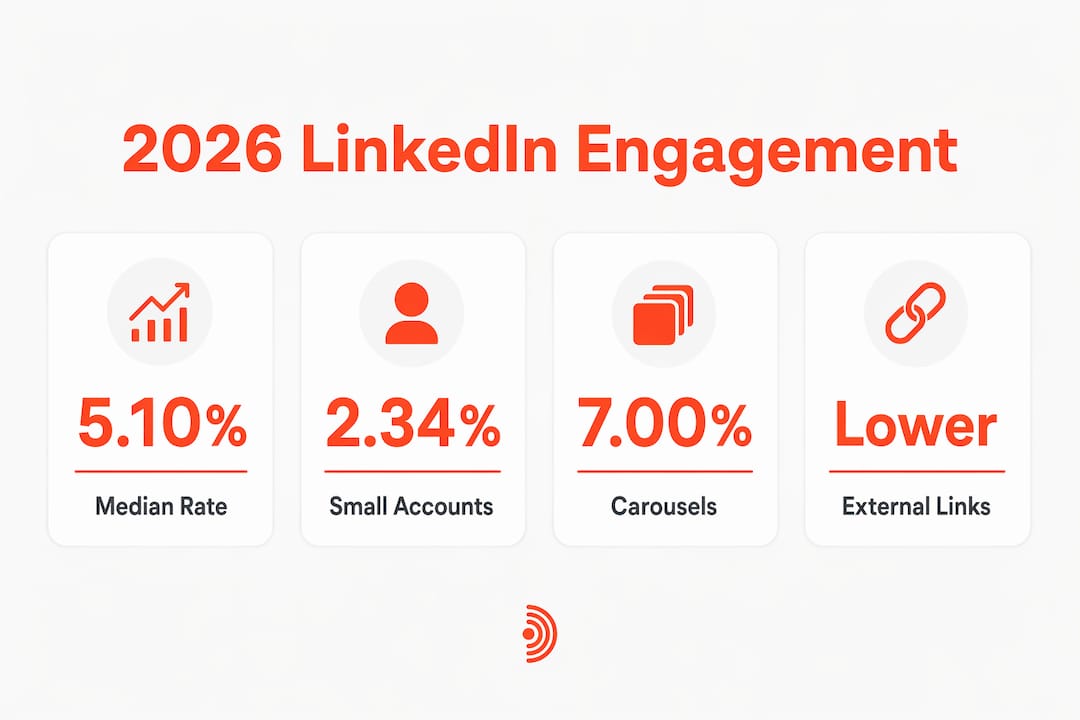
The follower-count effect is real and documented. Accounts with 1,000–5,000 followers average 2.34% engagement, while accounts with 50,000+ followers average 1.66%. That gap is not about content quality. It reflects audience diversity: larger pages attract followers with weaker intent, which dilutes engagement naturally.

Pro Tip: Always benchmark within your own size band and sector. A 50-person B2B tech firm comparing itself against a cross-industry average is measuring against a number that reflects no single real peer. Use the Oktopost benchmarking tool to pull your actual cohort's P50 and P90 figures.
For anyone running a LinkedIn click-through rate strategy, the same principle applies: impression-based metrics give you a cleaner signal on what content is actually working.
What commenting strategies actually move the engagement needle?
Strategic commenting is one of the most underused levers in B2B LinkedIn engagement. Most companies focus entirely on their own posts, while the real visibility opportunity sits inside other people's high-reach discussions.
Personalized, relevant comments in active threads do two things simultaneously: they signal expertise to the post's existing audience, and they trigger LinkedIn's algorithm to surface your profile more broadly. A generic "Great post!" does neither. A comment that adds a specific data point, a counterargument, or a practical example gets noticed.
Best practices that consistently produce results:
- Add substance, not affirmation. Comments that extend the conversation (a stat, a case, a question) earn more replies and profile clicks than praise.
- Respond within the first hour. Early comments on trending posts get disproportionate visibility before the thread gets crowded.
- Match your voice to the post's tone. A formal industry analysis deserves a different register than a founder's personal story.
- Comment consistently, not sporadically. One brilliant comment per month moves nothing. Showing up daily in the right threads builds recognition.
- Prioritize posts from accounts your prospects already follow. You are not just engaging with the poster; you are visible to their entire audience.
The challenge is consistency. Identifying the right posts, drafting comments that sound like you, and doing it every day across multiple accounts is genuinely time-consuming. That is where automation becomes relevant, not to replace judgment, but to handle the volume.
For a broader look at LinkedIn marketing tools that complement a commenting strategy, the options in 2026 are more capable than most B2B teams realize.
How Echoza automates personalized LinkedIn commenting without losing your voice
Echoza is built specifically for this problem. It ranks your LinkedIn feed to surface high-reach posts aligned with your niche, drafts comments in your voice based on your past activity and style, and holds every comment for your approval before anything goes live. Nothing posts without you seeing it first.
Core features:
- Feed ranking: surfaces posts where your comment will reach the most relevant people
- AI voice matching: drafts comments that reflect your actual tone and vocabulary, not a generic template
- Approval workflow: every comment sits in a queue for your review before scheduling
- Scheduled posting: approved comments go out across working hours, not in a suspicious burst
- Multi-account management: handles multiple LinkedIn profiles and voice profiles from one dashboard
- Daily activity caps: keeps engagement patterns within LinkedIn's acceptable limits
Users report measurable results after adopting Echoza, including increased profile views and direct client outreach that traces back to comment visibility rather than post performance.
Nicolas, a LinkedIn marketing professional who works with B2B clients on engagement strategy, puts it directly:
For B2B teams tracking lead generation outcomes alongside engagement metrics, Echoza's comment-driven visibility creates a pipeline touchpoint that most analytics dashboards do not even measure yet.
How engagement rates break down by LinkedIn post format
Format choice has a larger impact on engagement than most B2B marketers expect. The 2026 data from Socialinsider shows native documents leading the pack, with a 14% year-over-year increase in engagement performance. The reason is behavioral: carousels and PDFs slow the scroll, require active swiping, and generate saves and reshares at rates that text posts rarely match.
Here is how the major formats stack up on an impressions-based calculation:
| Format | Avg. Impressions-Based ER | Notes |
|---|---|---|
| Native document (carousel/PDF) | 7.00% | Saves and reshares drive amplification |
| Story-driven long-form text | Strong | Comments and shares dominate |
| Poll | High click rate | Low comment depth |
| Text only | Moderate | Fast to consume, lower dwell time |
| Single image with text | Below median | Competes with visual noise |
| Native video | Lower | Completion rates matter more than reactions |
| External link post | Lowest | LinkedIn suppresses off-platform links |
External link posts consistently underperform because LinkedIn's algorithm deprioritizes content that sends users away from the platform. If you need to share a link, putting it in the first comment rather than the post body is a widely used workaround that partially offsets the penalty.
Video is a nuanced case. Raw engagement rates look low, but impression counts tend to be higher, so the absolute number of people reached can still be significant. For B2B engagement tactics in 2026, the practical answer is to lead with documents and long-form text, use video for awareness, and avoid external links in the post body.
Common mistakes that skew your LinkedIn engagement measurement
Using follower count as the denominator is the most widespread error. It makes growing pages look like they are declining in performance, which leads to bad content decisions based on a misleading signal.
Benchmarking against the wrong peer group is the second. A mid-market company measuring itself against a cross-sector average that includes both 10-person startups and enterprise accounts is working with a number that applies to no one specifically. The April 2026 Oktopost data makes this concrete: the same sector produces a 37.9% P90 rate at the small-company band and a 15.2% P90 rate at the enterprise band. Chasing the wrong number leads to false failure or false confidence.
Other common errors worth flagging:
- Ignoring content type in the benchmark. A document carousel and a text post should not be measured against the same target rate.
- Measuring over too short a window. A single week of data is noise. Monthly averages across at least four posts give a reliable signal.
- Counting impressions from boosted posts alongside organic. Paid reach inflates impressions and deflates your organic engagement rate, making it look worse than it is.
- Overlooking comment quality as a metric. Raw engagement counts treat a reaction and a substantive comment as equivalent. They are not, for pipeline purposes.
Key Takeaways
The median B2B LinkedIn engagement rate is 5.10% in 2026, but your real benchmark depends on your company size, sector, and content format, not a cross-industry average.
| Point | Details |
|---|---|
| Median B2B engagement rate | 5.10% overall; native document posts average 7.00%, the highest of any format. |
| Size and sector variation | Top-decile tech firms with 11–50 employees hit 37.9%; large enterprises in the same sector reach 15.2%. |
| Use impression-based metrics | Divide total engagements by impressions, not followers, for an accurate read on content resonance. |
| Benchmark within your peer group | Compare against your own size band and sector; cross-industry averages reflect no single company accurately. |
| Commenting drives visibility | Consistent, personalized comments in high-reach threads build recognition and profile traffic that posts alone rarely generate. |