

LinkedIn marketing tools are software solutions that help marketers and business owners automate outreach, create content, manage ads, and measure ROI directly on LinkedIn. The platform's B2B targeting by job title, seniority, company, and skills makes it the most precise professional network for reaching decision-makers. Marketers who treat LinkedIn as a single channel, however, miss the point. The platform actually requires four distinct disciplines: organic content, outreach, paid advertising, and analytics. Professionals typically spend $39 to $99 per month on specialized tools because LinkedIn's native features alone do not cover all four disciplines well.
1. What are the core categories of LinkedIn marketing tools?
LinkedIn marketing involves four distinct jobs: organic content creation, efficient scheduling, lead outreach, and ROI analytics. Most tools excel at one or two of these jobs. Buying a catch-all platform that claims to do everything usually means you get mediocre performance across the board.
The four categories break down like this:
- Content creation and scheduling: Tools that help you draft posts, generate ideas with AI, and publish at optimal times for your audience.
- Outreach and lead generation: Platforms that automate connection requests, follow-up sequences, and personalized messages while staying within LinkedIn's daily limits.
- Advertising and campaign management: Solutions built around LinkedIn Campaign Manager, including AI creative tools, audience targeting, and ad variant testing.
- Analytics and attribution: Software that tracks content performance, ad spend, and pipeline revenue beyond what LinkedIn's native dashboard shows.
Pro Tip: Before you subscribe to anything, write down your single most important LinkedIn goal for the next 90 days. That goal determines which category of tool you actually need.
2. Top tools for LinkedIn content creation and scheduling
Organic content is the foundation of every effective LinkedIn presence. Consistent thought leadership and case studies build the credibility that paid ads depend on. Running ads without a credible organic presence is like sending cold emails from a blank profile.

AI-assisted writing tools help you move from blank page to published post faster. The best ones in this category learn your tone over time and suggest post angles based on trending topics in your industry. Scheduling features let you queue a week of content in one sitting, which protects your consistency even during busy periods.
Analytics platforms like Shield Analytics go further than LinkedIn's native data. They track impressions, follower growth, and engagement rates over months, not just the past 28 days. That long view reveals which post formats and topics actually build your audience.
Pricing in this category typically falls in the $39 to $79 per month range. Most platforms offer a free trial, so you can test whether the AI writing suggestions match your voice before committing.
Pro Tip: Schedule your posts for Tuesday through Thursday between 8:00 AM and 10:00 AM in your audience's time zone. Engagement data consistently shows professional audiences are most active during mid-week mornings.
3. Effective tools for outreach automation and lead generation
Outreach automation on LinkedIn carries real risk if done carelessly. Browser extension tools that simulate clicks inside your browser are detectable by LinkedIn and can trigger account restrictions. Cloud-based outreach platforms operate outside your browser, making them significantly safer for sustained campaigns.
The best outreach tools in 2026 offer visual flow builders that let you map multi-step sequences: connection request, then a personalized message, then a follow-up after a set number of days. Smart inbox systems consolidate replies so your sales team handles responses in one place rather than jumping between LinkedIn and a CRM.
Daily limit compliance is non-negotiable. LinkedIn enforces connection and message limits, and reputable automation platforms build those limits into their settings by default. Tools that let you override those limits are the ones that get accounts flagged.
Official LinkedIn Marketing Partners have direct API access, which produces up to 10x more company-level engagement data with lower compliance risk than tools relying on scraping. That data quality difference matters when you are building targeted outreach lists.
Pro Tip: Personalize the first line of every automated message with a specific detail about the recipient's recent post or company news. Generic openers get ignored; specific ones get replies.
4. Tools that enhance LinkedIn advertising campaigns
LinkedIn Campaign Manager is the required starting point for any paid LinkedIn strategy. Campaign Manager provides unmatched B2B audience targeting by job title, seniority, company size, and skills. Professional marketers layer Sales Navigator data on top of Campaign Manager to reach even more precise account lists.
LinkedIn recently integrated five new AI creative tools into Campaign Manager, including Brand Kit and Draft with AI. Brand Kit stores your logo, colors, and fonts so every AI-generated ad variant stays on brand. Draft with AI generates multiple ad copy variations from a single brief, cutting creative production time significantly for small marketing teams.
Thought Leader Ads are one of the most underused formats available. Introduced in 2023, this format lets you boost an individual employee's organic post as a paid ad. The result is authentic, less promotional content that consistently outperforms standard brand page ads in engagement.
Attribution is where most B2B advertising programs fall short. Connecting LinkedIn ad data directly to CRM systems and tracking account-level conversions is the difference between knowing your cost per click and knowing your cost per closed deal. Teams using predictive and matched audience features with CRM integration can achieve 3x pipeline ROI compared to teams running awareness campaigns without clear attribution.
| Ad format | Best use case | Key advantage |
|---|---|---|
| Sponsored Content | Brand awareness and thought leadership | High visibility in the feed |
| Thought Leader Ads | Amplifying employee posts | Authentic, higher engagement |
| Message Ads | Direct outreach to decision-makers | Personal, inbox-level reach |
| Dynamic Ads | Personalized profile-based targeting | Auto-personalized creative |
Pro Tip: Start every new LinkedIn ad campaign with Thought Leader Ads before spending on standard Sponsored Content. The engagement data you collect tells you which messages resonate before you scale spend.
5. LinkedIn analytics software and attribution platforms
Analytics tools fall into two groups: content performance trackers and ad attribution platforms. Content trackers show you which posts drive follower growth, profile visits, and inbound messages. Ad attribution platforms connect campaign spend to pipeline revenue in your CRM.
Native LinkedIn analytics cover the basics but cap historical data at 365 days for pages and show limited post-level detail for personal profiles. Third-party analytics platforms fill that gap with deeper historical data, competitor benchmarking, and exportable reports that your team can actually use in quarterly reviews.
For paid campaigns, attribution platforms pull data from LinkedIn Campaign Manager and match it against CRM records. That matching process reveals which ad campaigns influenced deals, not just which ones generated clicks. Without that connection, you are optimizing for metrics that do not correlate with revenue.
Organic content builds the credibility that paid ads rely on, so the smartest analytics setups track both organic and paid performance in a single dashboard. That combined view shows you whether your content investment is reducing your cost per lead on the paid side.
6. How to choose the right LinkedIn marketing tool for your goals
The most common mistake professionals make is buying a tool before defining their primary objective. A personal brand builder needs a content scheduling and analytics tool. A sales team running outbound campaigns needs a cloud-based outreach platform. A marketing team managing paid campaigns needs Campaign Manager plus an attribution solution.
Most LinkedIn marketing tools specialize in either organic visibility or paid lead generation, not both. Clarity about your priority saves you from paying for features you will never use.
A practical decision framework:
- Define your goal first. Organic visibility, outbound sales, paid lead generation, or analytics reporting each requires a different tool category.
- Match the tool to your role. Solo founders benefit most from content and scheduling tools. Sales teams need outreach automation. Marketing departments need ad management and attribution.
- Check for LinkedIn Marketing Partner status. Official partners have API access that produces better data and lower compliance risk.
- Test before you commit. Run a real campaign during the free trial period. If the tool does not produce measurable results in 30 days, move on.
- Budget for the right tier. Entry-level plans often cap the features that matter most. The $79 to $99 per month tier is where most professional-grade features become available.
Pro Tip: Stack tools by function rather than buying one platform that claims to do everything. A content tool plus an outreach tool plus Campaign Manager covers all four disciplines without the compromises of an all-in-one solution.
Key Takeaways
The most effective LinkedIn marketing strategy combines specialized tools for each discipline: content creation, outreach automation, ad management, and analytics.
| Point | Details |
|---|---|
| Specialize by function | Choose tools built for one discipline rather than all-in-one platforms that underperform across the board. |
| Organic content first | Consistent thought leadership builds credibility that makes paid ads more effective and less expensive. |
| Use cloud-based outreach | Cloud-based automation tools carry lower compliance risk than browser extensions and produce safer, scalable campaigns. |
| Connect ads to CRM | Attribution platforms that link LinkedIn ad data to CRM records reveal true pipeline ROI, not just click metrics. |
| Test before committing | Run a real campaign during the free trial period to confirm the tool delivers measurable results for your specific goals. |
What I have learned from using LinkedIn marketing tools across dozens of campaigns
Most professionals buy LinkedIn marketing tools the wrong way. They search for the highest-rated all-in-one platform, subscribe, and then wonder why results are mediocre six months later. The problem is not the tool. The problem is the mismatch between what the tool does well and what the buyer actually needs.
My experience is that the best-performing LinkedIn programs I have seen use three separate tools: one for content, one for outreach, and Campaign Manager for ads. That combination sounds like more work, but each tool does its job at a professional level. The all-in-one alternative forces you to accept compromises on every function.
The other mistake I see constantly is ignoring attribution. Marketers track impressions and click-through rates but never connect those numbers to closed revenue. If you cannot draw a line from a LinkedIn campaign to a deal in your CRM, you are flying blind on budget decisions.
LinkedIn is also not a single channel. It is a content platform, a sales tool, and an advertising network simultaneously. Treating it as one thing means you will always underperform on the other two. The professionals who win on LinkedIn pick their primary discipline, build the right tool stack for it, and measure results against revenue, not vanity metrics.
— Nicolas
Echoza: win more clients through LinkedIn comment engagement
Most LinkedIn marketing strategies focus on posts and ads. Comments are the overlooked channel where real conversations happen and where your target clients are already paying attention.
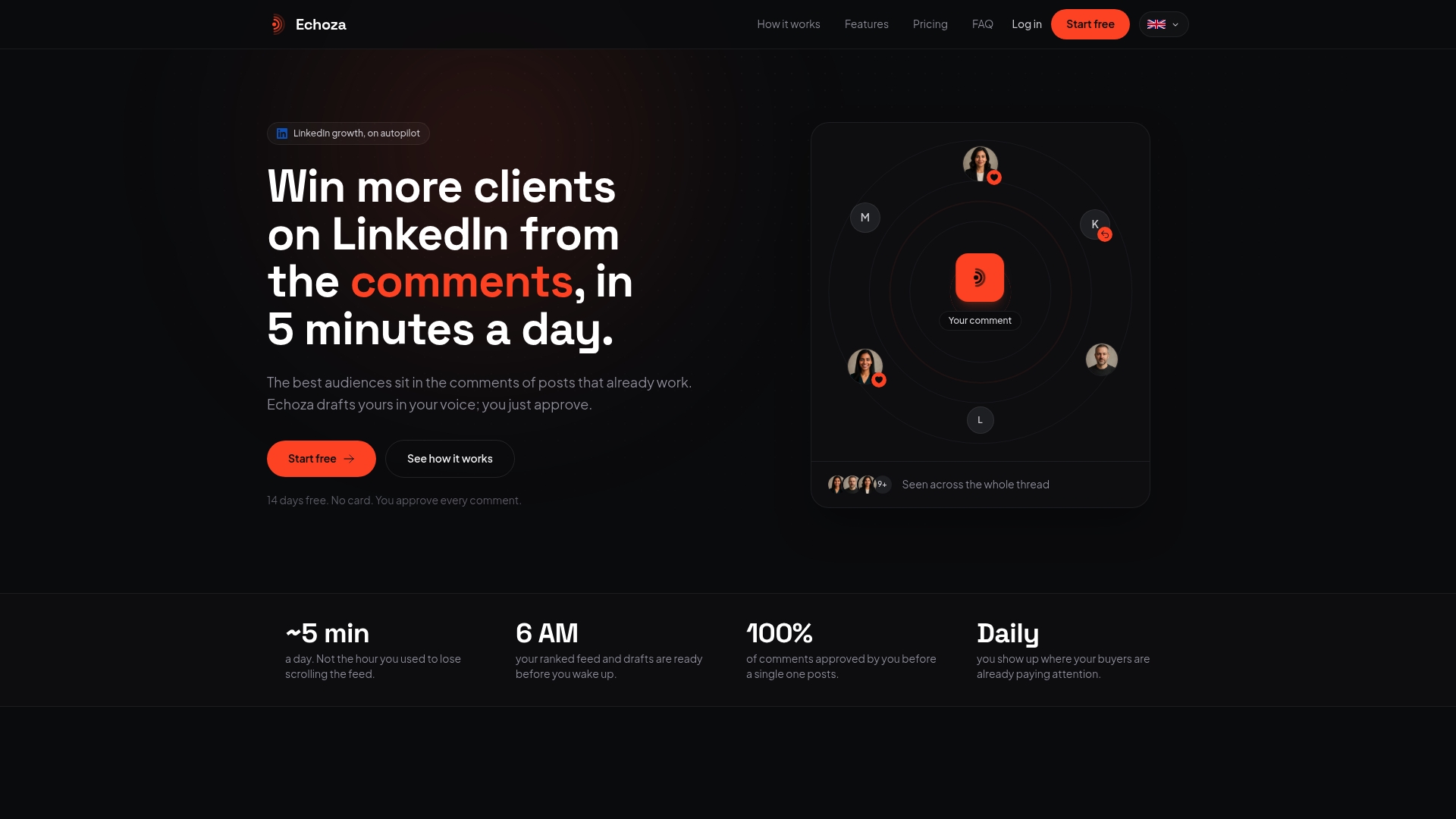
Echoza drafts comments in your voice and places them inside high-reach LinkedIn discussions where your ideal clients are already engaged. Instead of waiting for your posts to gain traction, you show up in conversations that already have an audience. Echoza users report measurable increases in profile views and inbound client outreach. Every comment goes through your approval before it posts, so your voice stays authentic. Echoza works alongside your existing content and outreach tools, adding a third engagement channel that most of your competitors are ignoring entirely.
FAQ
What are LinkedIn marketing tools?
LinkedIn marketing tools are software platforms that help professionals automate outreach, schedule content, manage paid campaigns, and measure ROI on LinkedIn. They fill gaps that LinkedIn's native features do not cover, particularly for organic personal branding and outreach automation.
How much do LinkedIn marketing tools cost?
Most specialized LinkedIn marketing tools cost between $39 and $99 per month. Enterprise-level attribution and analytics platforms typically price above that range and often require annual contracts.
What is the safest type of LinkedIn outreach automation?
Cloud-based outreach platforms are safer than browser extension tools because they operate outside your browser and are harder for LinkedIn to detect. Official LinkedIn Marketing Partners also carry lower compliance risk due to direct API access rather than scraping.
What are Thought Leader Ads on LinkedIn?
Thought Leader Ads are a LinkedIn ad format that lets you boost an individual employee's organic post as a paid ad. They consistently generate higher engagement than standard brand page ads because the content feels authentic rather than promotional.
Do I need LinkedIn Campaign Manager to run ads?
LinkedIn Campaign Manager is the required platform for all LinkedIn paid advertising. Third-party ad management tools and attribution platforms connect to Campaign Manager but do not replace it.